


Pokelike Pokemon Roguelike
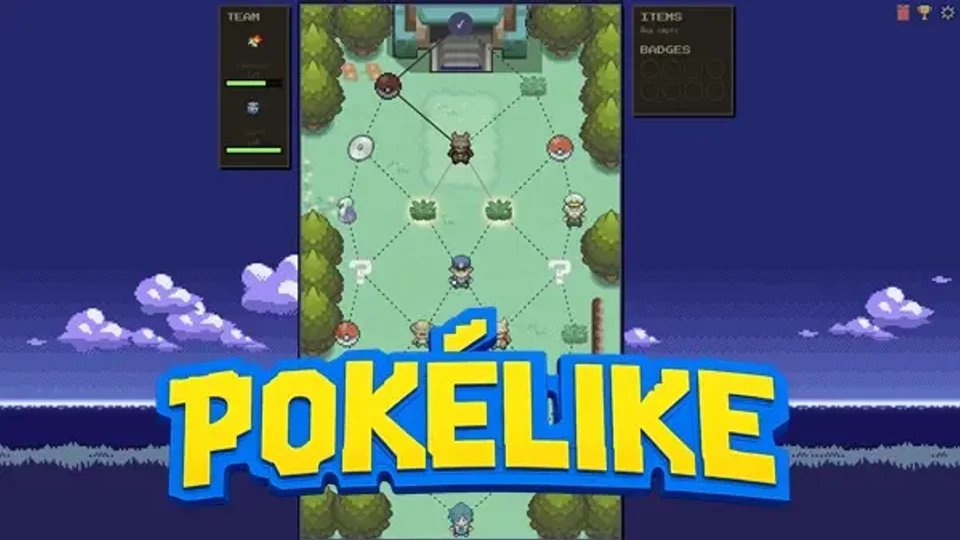
Pokelike is a Pokemon roguelike autobattler built around starter drafting, branching route choices, item rewards, trades, badges, and repeatable runs toward the Elite Four or Battle Tower.
Pokemon Strategy Compressed Into Runs
Pokelike is a fan-made Pokemon roguelike autobattler built around starter drafting, branching route choices, team ordering, item rewards, trades, badges, and repeat attempts toward major boss milestones. Instead of stretching a Pokemon-style adventure across towns, long routes, dialogue, and manual turn-by-turn commands, it concentrates the interesting decisions into a run structure. Pick a starter, move through events, catch or skip Pokemon, accept items, consider trades, reorder the squad, collect badges, and push toward the Elite Four or Battle Tower.
The autobattler label matters. Pokelike is not about twitch movement or manually choosing every attack during combat. The important decisions happen before and between fights: team composition, type coverage, lineup order, item assignment, trade timing, evolution planning, and route risk. A run can collapse because the team lacks an answer to a specific boss, but it can also be saved because one earlier item, catch, or trade gave the lineup exactly the role it needed.
Pokelike keeps the familiar strength of Pokemon team-building. Starters feel meaningful. Type matchups shape outcomes. Evolutions change the value of roster slots. Items can turn a solid Pokemon into a carry or keep a fragile option alive long enough to scale. The roguelike structure sharpens those ideas because weak choices follow the run forward. In a long RPG campaign, a bad decision can often be fixed through grinding. In Pokelike, recovery is limited, so every encounter and reward has more weight.
Pokelike's long-term structure includes Normal Mode, Nuzlocke, Battle Tower, Pokedex tracking, Achievements, Hall of Fame records, patch notes, community strategy notes, boss help, and run sharing. That layer matters because Pokelike is not only a single clear. It is a strategy sandbox where failed runs teach better future drafting.
Route Decisions and Team Shape
At a mechanical level, Pokelike asks you to convert limited choices into a team that can survive escalating checks. The opening is simple: choose your trainer, pick a starter, and begin moving through run events. After that, every node becomes a question. Is this wild encounter worth adding? Does the team need another attacker, a defensive pivot, a type answer, an evolution candidate, or a future trade piece? Should an item strengthen the current carry, protect a weak slot, or prepare for a boss several fights away?
The map flow creates roguelike tension. A safer route can preserve health and reduce immediate risk, but it may leave the team underpowered later. A riskier route can create momentum through stronger fights, better items, higher-level catches, or trades, but it can expose a fragile lineup before it is ready. Good Pokelike play means thinking two or three fights ahead instead of only choosing the reward that looks best right now.
Team order matters because automatic combat still needs structure. A strong Pokemon in the wrong slot may waste its advantage. A weaker Pokemon in the correct position can absorb a matchup, remove a threat, or protect a later carry. Reordering is not busywork. It is how roster knowledge becomes battle performance. When a route suddenly feels harder, the first fix is often a better lineup, not a new catch.
Items are another decision layer. A small reward can become powerful if it supports the right role. Offensive boosts help a carry finish fights before taking damage. Defensive items can keep a key Pokemon alive through a bad matchup. Utility effects can save a run that relies too much on one answer. Because item opportunities are limited, the best choice is rarely just the biggest number. The best choice solves the most dangerous upcoming problem.
Trades add uncertainty. A trade can fill a missing type, create a cleaner carry, upgrade level economy, or open an evolution path. It can also remove the only reliable answer to a later boss. That tension stops Pokelike from becoming a fixed checklist. A trade should be judged by what the team loses as much as by what it gains.
Normal, Nuzlocke, and Battle Tower
Normal Mode is the cleanest way to learn the run. It teaches starter value, encounter pacing, item priority, team order, boss preparation, and the danger of ignoring coverage. A first clear is mostly about avoiding obvious risk spirals: too many overlapping weaknesses, too few durable options, wasted items, and routes that chase short-term rewards while ignoring the next milestone.
Nuzlocke Mode changes the cost of mistakes. Losing a key Pokemon can reshape the attempt, and the best decisions are not always exciting. Sometimes the correct route is boring because it preserves the team. Sometimes a risky encounter is necessary because the current lineup cannot handle the next boss without a specific answer. That tension is familiar to Nuzlocke fans, but Pokelike's compressed structure makes the consequences arrive faster.
Battle Tower is the optimization lane, unlocked after a champion run is saved in the Hall of Fame. This makes sense mechanically. Battle Tower is best after the player understands basic route play, because it asks a stricter question: can this roster keep winning under repeated pressure?
The Pokedex, Achievements, Hall of Fame, patch notes, community tips, boss help, and run sharing extend the game beyond one victory. The Pokedex encourages trying different Pokemon instead of relying on one comfortable starter. Achievements create challenge routes and side goals. Hall of Fame records turn successful clears into a history of teams that worked. Patch notes matter because an active roguelike can shift item value, mode balance, boss difficulty, and route priorities.
Why Failed Runs Matter
Pokelike becomes much better when losses are treated as information. A failed Elite Four push may reveal missing coverage. A Nuzlocke loss may show where risk was mishandled. A Battle Tower streak may prove that a team was strong against one threat but weak against repeated matchup cycling. A bad trade may teach that the lost role mattered more than the gained stats. A wasted item may show that early comfort cost late survival.
This learning loop begins before the starter is chosen. If the previous run lacked a safe answer to Water, Grass, Electric, Psychic, or Flying threats, the next starter and route picks should account for that. If the previous team had too many special attackers or too little durability, the next run should value a different role. If one carry kept winning fights but collapsed against a boss, the next build needs a backup plan rather than a stronger version of the same weakness.
Because battles resolve automatically, clarity matters. A player needs to know why a Pokemon is on the team. Is it a lead, a wall, a type answer, an evolution investment, a trade candidate, a boss counter, or an item carrier? A team of individually strong Pokemon can still lose if they all fail the same matchup. A less flashy squad can win if every slot has a job.
The same discipline applies to encounters. Do not treat every catch as an upgrade. A new Pokemon should fill a role, improve coverage, evolve into something useful, enable a trade, or replace a weak slot. If it does none of those things, skipping or keeping the current structure may be stronger. Pokelike rewards saying no.
Practical First Clear Plan
For a first clear, choose a starter you understand and build around coverage rather than favorites alone. Keep one reliable answer for common weaknesses, protect future evolutions long enough for them to matter, and avoid spending every item immediately. If a later boss is likely to create a sharper need, saving the right item can be stronger than smoothing out an easy fight.
Read routes in terms of role pressure. A Pokemon Center node has different value if the current squad is damaged. A trade node has different value if the team has an expendable slot. A battle node has different value if the team needs levels more than new bodies. A move tutor or item node can be run-winning if it fixes a specific matchup. The strongest route is the one that improves the next hard fight, not the one that looks safest on the current screen.
Before a boss, reorder the team deliberately. Put the best answer where it actually meets the threat. Move fragile Pokemon away from bad openings. Assign items to the role that needs them most. If the team has no good answer, identify the least damaging path through the fight rather than hoping raw strength solves it.
Pokelike concentrates Pokemon-style strategy without the slower travel layer. Planning matters more than reflexes, Nuzlocke pressure turns risk into a real cost, and team-building has to prove itself across repeated checks. The reward is seeing a team form from partial information, survive imperfect choices, and eventually make the final stretch feel earned.